FateRune editorial journal
What Is BaZi? A Beginner's Guide to Chinese Astrology and the Five Elements
A plain-English guide to BaZi, the Four Pillars of Destiny, the Five Elements, Day Master logic, and what a BaZi birth chart can actually reveal.

Key takeaways
What this article helps you see faster
- A plain-English guide to BaZi, the Four Pillars of Destiny, the Five Elements, Day Master logic, and what a BaZi birth chart can actually reveal.
- A clearer read on what does bazi mean?.
- A clearer read on where does bazi come from?.
- A clearer read on what are the five elements in bazi?.
In this article
Turn curiosity into something personal
Educational articles help you understand the language. A full report turns that language into a reading built around your own timing, relationship pattern, or work direction.
Most people come to BaZi the same way: someone mentions it, you half-recognize the term, and then you spend forty minutes reading fragments from five different sites, each one assuming you already know what a Heavenly Stem is.
This guide starts from zero. No assumed knowledge. No jargon without explanation. By the end, you will know what BaZi actually is, how the Five Elements shape its logic, and what a BaZi chart can and cannot tell you.
What does BaZi mean?
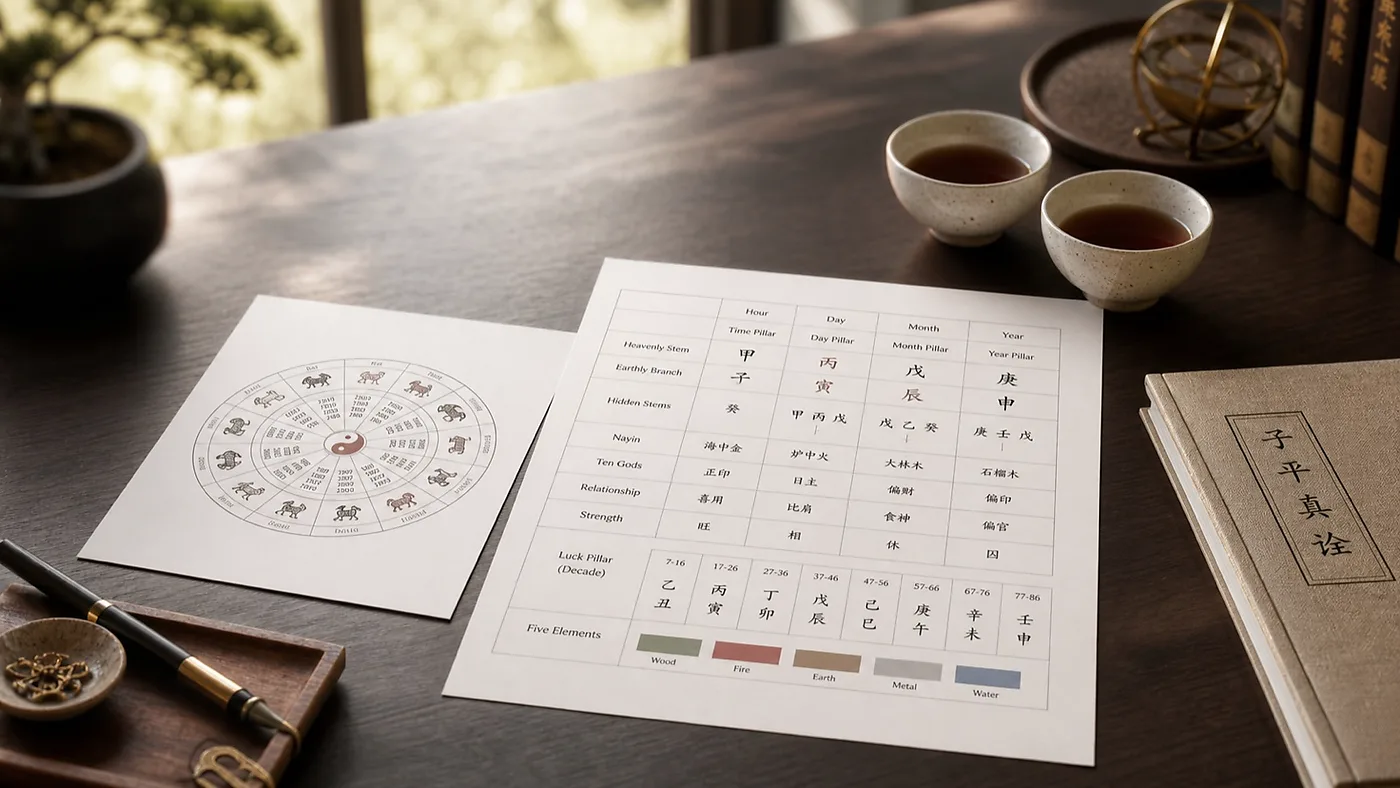
BaZi is a Chinese word that literally translates to "eight characters." It is a system of Chinese astrology that uses your exact birth date and time — year, month, day, and hour — to build a birth chart made up of eight Chinese characters.
Each of those eight characters carries information about the natural world: the season, the energy, the element. Taken together, they form a kind of energetic blueprint of the moment you were born. BaZi practitioners use that blueprint to analyze personality tendencies, life timing, relationship patterns, and career direction.
It is sometimes called the Four Pillars of Destiny in English, because the eight characters are organized into four pairs, each pair called a "pillar." Each pillar represents one unit of time: your birth year, month, day, and hour.
Where does BaZi come from?
BaZi developed in China over more than a thousand years, drawing on classical Chinese cosmology, Taoist philosophy, and observation of natural cycles. It became formalized during the Tang and Song dynasties and has been practiced across East Asia ever since.
Unlike Western astrology, which maps the positions of planets against a backdrop of constellations, BaZi is rooted in calendar time and the Five Elements system. It does not track where Jupiter was when you were born. It tracks what kind of elemental energy was flowing through the natural world at that exact moment.
What are the Five Elements in BaZi?
The Five Elements — known in Chinese metaphysics as Wu Xing — are the foundation of BaZi logic.
Wood
Wood represents growth, expansion, upward movement, and new beginnings. Think of a tree pushing through concrete to reach light. Wood energy is associated with vision, flexibility, and the drive to develop.
Fire
Fire represents warmth, passion, visibility, and transformation. It is the element of expression, creativity, connection, and emotion. Fire energy is bright and intense but also short-lived without fuel.
Earth
Earth represents stability, practicality, nurturing, and grounding. It sits at the center of the Five Elements cycle, acting as a mediator between the others. Earth energy is reliable, steady, and concerned with security and care.
Metal
Metal represents structure, refinement, precision, and authority. It is the element of clarity, boundaries, discipline, and the kind of strength that comes from being shaped under pressure. Metal energy tends toward perfectionism and decisive action.
Water
Water represents wisdom, depth, adaptability, and flow. It moves around obstacles rather than through them. Water energy is intuitive, reflective, and comfortable with ambiguity in ways the other elements are not.
How do the Five Elements interact?
What makes BaZi more than a personality typing system is the way the Five Elements relate to each other. There are two primary cycles.
The Generating Cycle — one element produces and supports the next:
- Wood feeds Fire
- Fire creates Earth (ash)
- Earth produces Metal (ore from the ground)
- Metal collects Water (condensation)
- Water nourishes Wood
The Controlling Cycle — one element checks and limits another:
- Wood breaks up Earth (roots)
- Earth absorbs Water (a dam)
- Water extinguishes Fire
- Fire melts Metal
- Metal cuts Wood
In a BaZi chart, these relationships between elements show where someone has natural support, where they face friction, and what kinds of seasons or life periods tend to bring out their best or create pressure.
What are the Heavenly Stems and Earthly Branches?
The eight characters in a BaZi chart come from two sets of symbols.
The Ten Heavenly Stems cycle through the Five Elements in both Yin and Yang form. Wood, for example, appears as Yang Wood (Jia) — like a tall tree — and Yin Wood (Yi) — like a vine or flower. Each element has two Stems, giving ten in total.
The Twelve Earthly Branches correspond to the twelve animals of the Chinese zodiac — Rat, Ox, Tiger, Rabbit, Dragon, Snake, Horse, Goat, Monkey, Rooster, Dog, and Pig. Each Branch also carries one or more of the Five Elements within it, making them richer and more layered than their animal labels suggest.
Each of your four pillars is made of one Stem and one Branch, which is where the "eight characters" count comes from.
What does your Day Master mean?
Your Day Master is the Heavenly Stem sitting in the Day Pillar. It is considered the most important single character in your chart, because it represents you — your core nature, your self.
Everything else in the chart is read in relation to your Day Master. The other seven characters either support it, challenge it, drain it, or sharpen it. That interaction tells a BaZi reader how well your natural energy tends to flow, and what kinds of environments and timing tend to bring out your strengths.
For example, a Yang Wood Day Master has a natural drive toward leadership and long-term vision. But whether that drive flourishes or struggles depends heavily on what the rest of the chart looks like: whether there is enough Water to nourish the Wood, whether Metal in the chart cuts it back productively or excessively, and what elemental energies are flowing in the current ten-year cycle.
What can BaZi actually tell you?
BaZi is most useful as a framework for understanding patterns — not as a fortune-telling machine.
What it tends to do well:
- Describing natural personality tendencies and stress responses
- Identifying which life areas (career, relationships, health, money) tend to need more attention
- Highlighting timing: which years or decades carry more supportive energy for specific decisions
- Explaining why the same kind of situation keeps repeating
What it cannot do:
- Predict specific events with certainty
- Tell you the outcome of a particular decision
- Remove the role of free will and personal choice
The most honest way to approach a BaZi reading is as a map. A map does not tell you what to do. It tells you what the terrain looks like. You still decide where to go.
How is BaZi different from Western astrology?
Western astrology and BaZi are distinct systems, but they are often used together because they answer slightly different questions.
Western astrology places your birth against a backdrop of planetary positions and zodiac signs. It tends to be strong on psychological depth, narrative arcs, and the symbolic meaning of planetary cycles like Saturn returns or Jupiter transits.
BaZi works from calendar time and elemental energy. It tends to be more structured and chart-based, with clearer logic for reading timing windows. It is also more explicitly tied to ideas about balance: a chart with too much of one element and too little of another has a different character than a chart where elements are more evenly distributed.
A combined reading — one that draws on both Western birth chart analysis and BaZi logic — can give you more angles on the same question. This is what FateRune is designed to do: rather than asking you to choose between systems, it uses both to build a more complete picture.
Do you need your birth time?
For a full BaZi chart, birth time matters. Your Hour Pillar — the fourth pillar — requires it, and the Hour Pillar carries information about career direction, later life, and how you tend to appear to others.
That said, a reading built on just your birth date (Year, Month, and Day Pillars) can still be meaningful. It simply leaves out one quarter of the chart. If you have any record of your approximate birth time — even a range of a few hours — that is worth including.
How do you read your own BaZi chart?
The short answer is that it takes time. BaZi has a learning curve, partly because of the Chinese characters and classical vocabulary, and partly because reading a chart well requires understanding how all the elements interact, not just reading each one in isolation.
Most people start by identifying their Day Master and reading about its characteristics. From there, they look at what elements are strongest and weakest in the chart, and what the current ten-year luck cycle says about the timing they are currently in.
A structured BaZi report skips the research phase and gives you the interpretation directly: what your Day Master means, how the elements in your chart balance, what the current luck cycle suggests for career, love, and timing, and where the useful five-element feng shui signals point.
BaZi beginners FAQ
Is BaZi the same as Chinese zodiac?
No. The Chinese zodiac is based only on your birth year, giving twelve possible animal signs. BaZi uses your full birth date and time, producing a much more individualized chart with eight characters rather than one animal.
Can two people born on the same day have different BaZi charts?
Yes, if they were born in different hours. The Hour Pillar alone creates twelve possible variations for the same birth date. Even without the Hour Pillar, year, month, and day together produce a large number of possible chart combinations.
Is BaZi only for Chinese people?
No. BaZi is a system based on calendar time and natural cycles, not ethnicity or culture. It has been adopted and studied across East Asia and increasingly in Western countries. Your birth date and time are the only inputs that matter.
Do I need to believe in astrology for BaZi to be useful?
You do not need to believe anything. Most people find it most useful as a reflective framework: a structured way to think about personality, timing, and recurring patterns. Whether the mechanism is literal or metaphorical matters less than whether the reflection produces useful questions.
What is the difference between BaZi and Zi Wei Dou Shu?
Both are Chinese astrology systems. BaZi focuses on the Four Pillars derived from birth date and time, with emphasis on elemental balance and timing cycles. Zi Wei Dou Shu (Purple Star Astrology) uses a more complex palace-based chart system with over a hundred stars assigned to twelve life palaces. They are complementary: BaZi tends to be clearer on timing; Zi Wei Dou Shu tends to be richer on life area detail.
Ready to see your own chart?
If you want to go further than theory, the most direct next step is to see your own BaZi chart with an interpretation attached. FateRune's birth chart report combines your BaZi profile, Western birth chart, and Zi Wei Dou Shu elements into one structured result — with timing windows, element balance scores, and plain-English reasoning you can actually use.
Start with a free preview to see what your chart contains before you decide whether to unlock the full report.
How to use this topic well
Use the five elements as a regulation tool. Ask what is overused, what is missing, and how your current pace needs to be balanced rather than taking the labels literally.
Sources & references


