FateRune editorial journal
What Are the “Secrets of Heaven”? A Beginner’s Guide to Daoist Divination in Chinese Culture
Discover the meaning of Heaven’s secrets in Chinese Daoism and learn how ancient divination arts like the I Ching, astrology, feng shui, and destiny reading shaped traditional Chinese culture.
Key takeaways
What this article helps you see faster
- Discover the meaning of Heaven’s secrets in Chinese Daoism and learn how ancient divination arts like the I Ching, astrology, feng shui, and destiny reading shaped traditional Chinese culture.
- A clearer read on what are the “secrets of heaven”?.
- A clearer read on what do the “secrets of heaven” mean in daoist thought?.
- A clearer read on how did ancient china try to reveal heaven’s secrets?.
In this article
Turn curiosity into something personal
Educational articles help you understand the language. A full report turns that language into a reading built around your own timing, relationship pattern, or work direction.
What are the “Secrets of Heaven”?
In Chinese culture, few ideas sound as mysterious as the “secrets of Heaven”. The phrase suggests that the universe holds hidden patterns, and that some people, through ancient wisdom and disciplined observation, may be able to read them.
This idea has deep roots in Daoism, classical Chinese philosophy, and traditional Chinese divination practices. For centuries, people used systems like the I Ching, Chinese astrology and destiny reading, feng shui, face reading, palm reading, and date selection to understand timing, luck, character, and change.
So what exactly are the “secrets of Heaven”? And how did traditional Chinese culture attempt to reveal them?
What do the “Secrets of Heaven” mean in Daoist thought?
The phrase Heaven’s secrets comes from early Daoist thought, especially the way classical texts describe the unseen order behind natural change. Originally, it did not simply mean fortune-telling. It referred more deeply to the natural order of the universe: the hidden rhythm that shapes all things.
In Daoist philosophy, Heaven is not only the sky. It represents a higher order, a cosmic rhythm, and the principle behind change. To understand human life, one must first understand the greater movement of nature.
Over time, the meaning of “Heaven’s secrets” expanded. It came to include ideas such as destiny, timing, fate, natural law, and the rise and fall of people and nations. In this sense, the phrase became a way of talking about the hidden logic behind life.
How did ancient China try to reveal Heaven’s secrets?
Ancient Chinese thinkers believed that nature, time, and human life were deeply connected. Because of this, they developed systems to observe patterns and interpret change. These systems were not always treated as isolated spiritual practices. They were often connected to calendars, astronomy, ritual, land use, medicine, politics, and everyday decision-making.
At the center of this worldview was a simple idea: if Heaven, Earth, and human life correspond to each other, then visible signs may reveal deeper patterns.
I Ching divination: the foundation of Chinese divination
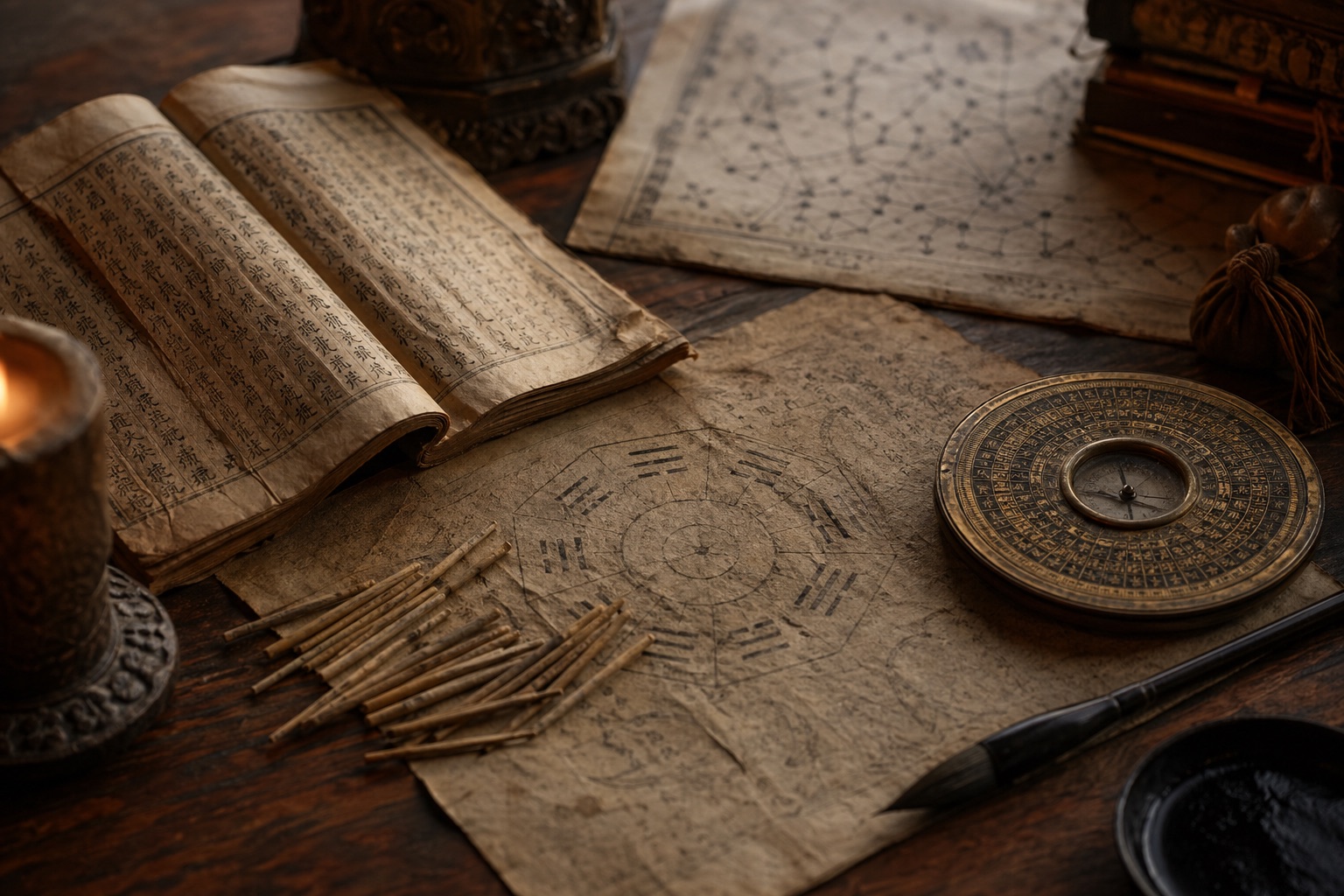
One of the earliest and most influential systems is the I Ching, also called the Book of Changes. According to tradition, the culture hero Fuxi observed the patterns of Heaven above and Earth below, and from these observations created the trigrams that later formed the hexagrams of the I Ching.
The I Ching is more than an oracle book. It is a symbolic system that explains how change happens in life and nature. Each hexagram points to a pattern of movement: growth, restraint, conflict, waiting, transformation, return, or completion.
In practical use, I Ching divination was not only about asking “What will happen?” It was also about asking “What kind of situation am I in, and what response fits the timing?”
Oracle methods: turtle shells, yarrow stalks, and symbolic signs
Before later metaphysical systems developed, ancient Chinese divination often relied on two classic methods. Bo involved heating turtle shells or animal bones and reading the cracks. Shi involved using yarrow stalks to calculate symbolic numbers.
These practices were not viewed as random guesswork. They were based on the belief that visible signs in nature reflected deeper truths. A crack, number, direction, day, star, or bodily feature could become meaningful when read within the right symbolic framework.
What is Shushu? The Chinese arts of calculation
As Chinese metaphysical traditions evolved, many practices came to be grouped under the term shushu, often translated as the arts of calculation, numerological arts, or traditional Chinese metaphysics.
These systems were built on core ideas such as Yin and Yang, the Five Elements, cycles of time, and the correspondence between Heaven, Earth, and human life.
From this foundation, many methods emerged, including destiny reading, feng shui, date selection, physiognomy and palm reading, dream interpretation, Chinese astrology, omen reading, and ritual timing. Together, these formed a large body of knowledge used to interpret luck, timing, health, relationships, environment, and political change.
Why was Chinese divination important in traditional society?
In early Chinese civilization, divination was not always seen as marginal or merely superstitious. It often played an important role in both official and everyday life.
Rulers and elites consulted diviners for marriage dates, ritual timing, military decisions, burial sites, omens, and celestial events. Ordinary people also used these systems to seek clarity in family matters, health concerns, work, relationships, and personal destiny.
Over time, these practices developed a unique double identity. Some remained connected to court ritual and scholarship, while others moved into folk culture and were practiced by wandering specialists, fortune-tellers, and ritual experts. Chinese divination therefore belonged both to high intellectual tradition and to the popular world of everyday life.
Which Chinese divination arts became most influential?
Several systems became especially important across Chinese history. Each one used a different symbolic language, but they shared the belief that life follows patterns and those patterns can be observed.
1. I Ching divination
Used to understand change, timing, and decision-making through hexagrams.
2. Feng shui
Focused on the flow of energy in land, buildings, rooms, and burial sites.
3. Chinese astrology and destiny reading
Used birth data and calendrical systems to analyze personality, timing, fate, and life direction.
4. Physiognomy and palm reading
Interpreted the body, face, and hands as reflections of character and life patterns.
5. Auspicious date selection
Helped determine favorable times for marriage, travel, business, rituals, and major life events.
Who was believed to be able to read Heaven’s secrets?
Traditional culture did not assume that everyone was suited for these practices. A serious diviner was expected to have more than technical knowledge. They were often expected to have patience, discipline, moral steadiness, intuition, deep study, and symbolic thinking.
Some traditions also believed certain people were naturally drawn to mystical knowledge because of temperament or destiny. Such people were often described as thoughtful, curious, solitary, and highly sensitive to patterns.
At the same time, traditional belief carried a warning: revealing too much of Heaven’s secrets could come at a cost. Some believed that practitioners who probed too deeply into fate might weaken themselves physically or spiritually. Because of this, spiritual cultivation and ethical conduct were often seen as essential for serious practitioners.
Was Chinese divination only about prediction?
Not at all. One of the most interesting things about Chinese divination is that it often did more than predict events. It also offered moral reflection and practical guidance.
A reading might suggest how to act with integrity, how to improve family harmony, when to be patient, when to let go, or how to build merit and character. In that sense, Chinese divination was often as much about how to live as about what might happen next.
How should we view Daoist divination today?
Today, it helps to approach Chinese divination with both respect and discernment. Some traditional practices overlap with areas we now understand through different lenses, such as astronomy and calendrical science, architecture and environmental design, medicine and observation, psychology and symbolic interpretation.
Other aspects remain spiritual, mystical, or difficult to verify in modern scientific terms. Rather than dismissing everything or believing everything blindly, a balanced approach is to ask: what cultural wisdom, symbolic value, or practical insight can still be learned here?
Why the “Secrets of Heaven” still fascinate people
The idea of hidden patterns behind life still speaks to people today. In uncertain times, many people are not just looking for prediction. They are looking for meaning, direction, timing, language for inner experience, and a deeper connection between life and the universe.
That is why the “secrets of Heaven” still feel powerful. They are not only about mystery. They are about the human desire to understand change. At their best, these traditions offer a symbolic way to reflect on life, make decisions, and search for alignment.
Final thoughts
The Chinese arts of divination are an important part of traditional culture. They influenced religion, politics, warfare, medicine, architecture, and everyday life for centuries.
Behind the phrase “Heaven’s secrets” lies a larger worldview: that life is not random, that nature has rhythm, and that human beings are part of a greater pattern.
Whether one sees these systems as spiritual tools, cultural heritage, or symbolic philosophy, they remain one of the most fascinating parts of Chinese civilization.
FAQ: Daoist divination and the secrets of Heaven
What are the “secrets of Heaven” in Chinese culture?
They refer to the hidden patterns of nature, destiny, timing, and cosmic order believed to shape life and events.
What is Daoist divination?
Daoist divination refers to traditional practices influenced by Daoist thought, including the I Ching, feng shui, astrology, and other metaphysical methods used to interpret change and timing.
Is Chinese divination the same as fortune-telling?
Not exactly. While prediction is one part of it, many systems are also about self-reflection, timing, ethics, and understanding patterns in life.
What is shushu in Chinese tradition?
Shushu refers to the traditional Chinese arts of calculation, including divination, astrology, destiny analysis, feng shui, and other systems based on Yin-Yang and the Five Elements.
Why is divination important in Chinese history?
It influenced statecraft, ritual, military planning, medicine, architecture, and everyday decision-making across many dynasties.
How to use this topic well
Use the five elements as a regulation tool. Ask what is overused, what is missing, and how your current pace needs to be balanced rather than taking the labels literally.
Sources & references