FateRune editorial journal
Purple Star Astrology Explained for Beginners: What Zi Wei Dou Shu Can Reveal
A beginner-friendly guide to Purple Star Astrology, also known as Zi Wei Dou Shu. Learn how Purple Star charts use stars, palaces, and timing cycles to read personality, relationships, career, and life patterns.

Key takeaways
What this article helps you see faster
- A beginner-friendly guide to Purple Star Astrology, also known as Zi Wei Dou Shu. Learn how Purple Star charts use stars, palaces, and timing cycles to read personality, relationships, career, and life patterns.
- A clearer read on what is purple star astrology?.
- A clearer read on what does zi wei dou shu mean?.
- A clearer read on how does purple star astrology work?.
In this article
Turn curiosity into something personal
Educational articles help you understand the language. A full report turns that language into a reading built around your own timing, relationship pattern, or work direction.
If you have been researching Chinese astrology or looking for something deeper than a generic horoscope, you may have come across the phrase Purple Star Astrology.
It sounds mysterious at first. The traditional name, Zi Wei Dou Shu, can feel even more intimidating. But the basic idea is simple enough: Purple Star Astrology is a Chinese chart-reading system that organizes life themes into a structured map. Instead of giving one broad zodiac label, it looks at birth data, symbolic stars, twelve life palaces, and timing cycles.
This beginner guide explains what Purple Star Astrology means, how Zi Wei Dou Shu works, what a Purple Star chart can reveal, and what to know before getting a reading.
What Is Purple Star Astrology?
Purple Star Astrology is the common English name for Zi Wei Dou Shu (紫微斗数), a traditional Chinese astrology system. It is one of the better-known systems in Eastern astrology and is often used to understand personality, relationships, career direction, marriage themes, and life timing.
Unlike a simple yearly animal sign, Purple Star Astrology usually uses more detailed birth information:
- birth year
- birth month
- birth day
- birth hour
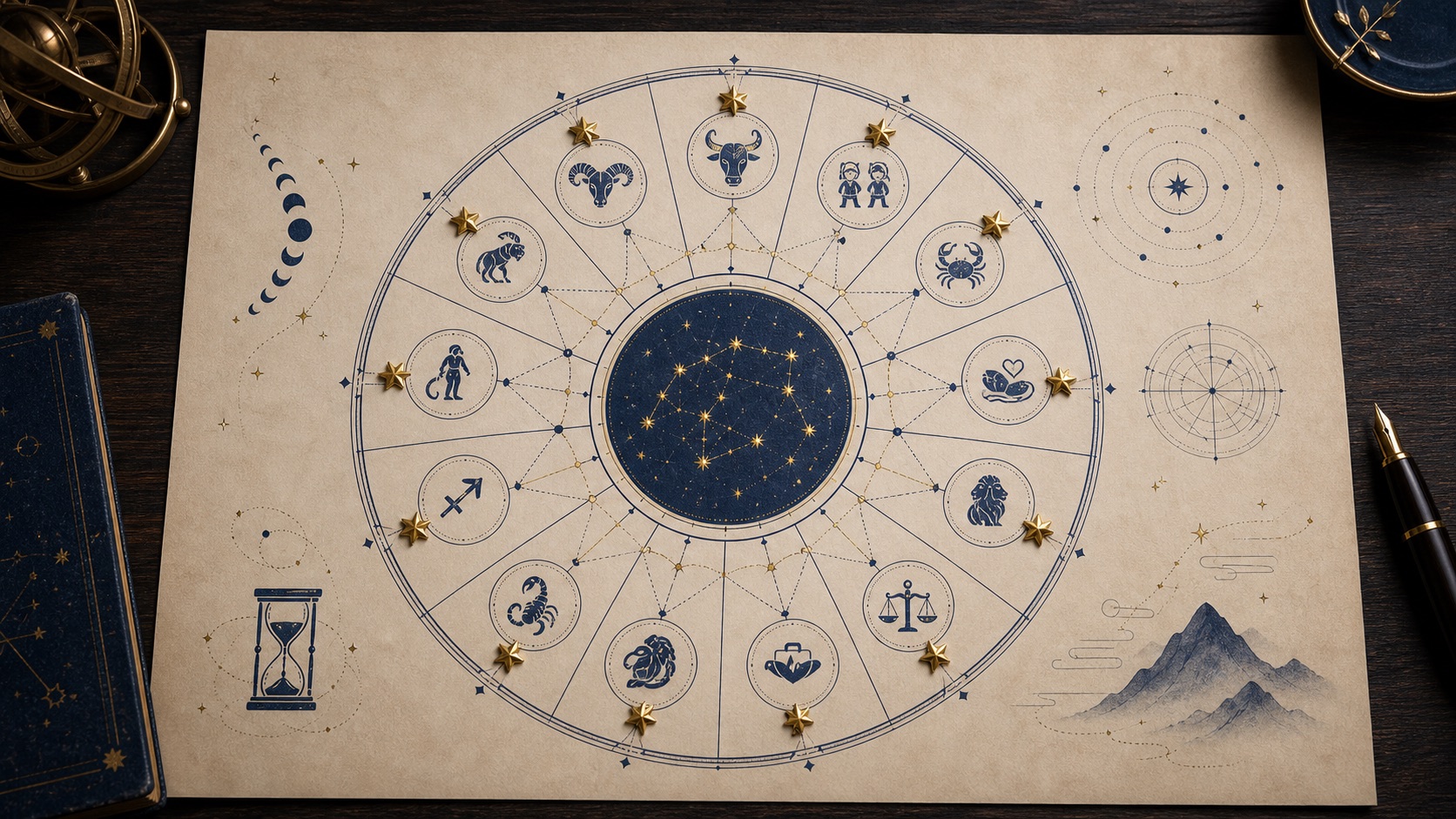
From that information, a Purple Star chart is built. The chart contains symbolic stars placed across twelve life palaces. Those palaces represent different areas of life, such as identity, relationships, wealth, health, family, travel, and career.
If you are completely new to this system, the simplest way to think about it is this: Zi Wei Dou Shu is a structured life map that uses stars and palaces to describe recurring patterns over time.
What Does Zi Wei Dou Shu Mean?
The Chinese name Zi Wei Dou Shu is often translated as Purple Star Astrology or Purple Star Calculation. Zi Wei refers to the Purple Star, a symbol associated with central order and authority in traditional Chinese cosmology. Dou Shu points toward star-based calculation and interpretation.
For beginners, the term can sound technical. But the purpose is human and practical. A Zi Wei Dou Shu reading is not only asking, “What sign are you?” It asks:
- Where do your patterns tend to repeat?
- Which parts of life become louder at different times?
- How do relationships, career, resources, family, and timing influence one another?
- What kind of environment helps your strengths work better?
How Does Purple Star Astrology Work?
A Purple Star chart is divided into twelve palaces. Each palace describes a major area of life. Different schools may use slightly different translations, but the core structure usually includes themes such as:
- self and identity
- siblings and close connections
- marriage and partnerships
- children and legacy
- wealth and resources
- health and wellbeing
- travel and movement
- friends and networks
- career and status
- property and home
- parents and support systems
The stars are then placed into these palaces according to the birth data. Each star has symbolic meaning. The reading comes from how those stars appear, where they sit, how the palaces relate to each other, and how timing cycles activate different parts of the chart.
Purple Star Astrology vs Western Astrology
One common beginner question is whether Purple Star Astrology is the same as Western astrology. It is not. They can both be used for self-understanding, but they organize the chart differently.
Western astrology often focuses on planets, zodiac signs, aspects, houses, and transits. Purple Star Astrology focuses more on symbolic stars, twelve palaces, fate patterns, and timing cycles.
For example, Western astrology might ask what Venus says about your love style. Purple Star Astrology may look at the relationship palace, the stars placed there, the connected palaces, and the timing cycle that affects partnership themes.
Neither system is automatically better. They are different symbolic languages. Western astrology often feels psychological and planetary. Zi Wei Dou Shu can feel more structural, like a map of how life areas interact across time.
What Can Purple Star Astrology Reveal?
A Purple Star Astrology reading can be used in several life areas. The best readings do not reduce you to one label. They show patterns and contradictions, which is often why the system feels nuanced.
Personality and Character
A Purple Star chart may describe natural strengths, emotional tendencies, leadership style, pressure points, and inner contradictions. It can show where someone appears steady but carries hidden intensity, or where a person seems flexible but needs a clear structure to thrive.
Career and Life Direction
Many people explore Zi Wei Dou Shu because they want career clarity. A reading may point toward patterns such as leadership versus support roles, stability versus reinvention, public visibility versus private expertise, or structure versus flexibility.
If career is your main question, you may also want to read our guide on what your chart can say about work style.
Love and Relationships
Purple Star Astrology is also used to explore romantic patterns, emotional needs, marriage tendencies, compatibility themes, and repeating relationship lessons. It does not simply say whether two people are “good” or “bad” together. A careful reading looks at what kind of bond is easy, what becomes pressured, and what timing may bring certain relationship questions forward.
For a wider relationship angle, see what love compatibility really means in astrology.
Timing and Life Cycles
Timing is one reason Purple Star Astrology attracts serious interest. The chart can be read through cycles that suggest different life seasons: growth, pressure, change, opportunity, emotional intensity, or rebuilding.
This does not mean every event is fixed. A timing cycle is better understood as a period where certain themes become more active and deserve more attention.
Is Purple Star Astrology the Same as the Chinese Zodiac?
No. The Chinese zodiac is based mainly on your birth year and assigns one of twelve animal signs, such as Rat, Ox, Tiger, Rabbit, Dragon, Snake, Horse, Goat, Monkey, Rooster, Dog, or Pig.
Purple Star Astrology is more detailed. It uses full birth information to build a chart with palaces and stars. The Chinese zodiac can describe a broad symbolic identity. Zi Wei Dou Shu is closer to a complete chart system.
Both belong to the wider world of Chinese astrology, but they are not the same tool.
What Do You Need for a Zi Wei Dou Shu Reading?
For the most precise Purple Star chart, you generally need your date of birth and exact birth hour. Birth time matters because it affects the structure of the palaces and the way stars are placed.
If you do not know your exact time of birth, the reading may become less precise. You can still learn broad themes, but detailed palace interpretation and timing may need more caution. This is similar to Western astrology, where missing birth time can affect the rising sign and houses. You can read more in our article on birth chart reading without birth time.
Is Purple Star Astrology Useful for Beginners?
Yes, if it is explained clearly. The traditional chart can look overwhelming at first because there are many stars, palace names, cycles, and technical rules. But most beginners are not really looking for technical language. They are asking human questions:
- What kind of person am I becoming?
- Why do certain patterns repeat?
- What kind of work fits my temperament?
- What should I understand about love and timing?
- Where does my life feel blocked or overextended?
That is where Purple Star Astrology for beginners becomes useful. You do not need to master every star name right away. Start by understanding the chart’s main idea: life has different areas, different timing seasons, and repeating symbolic patterns.
Final Thoughts
Purple Star Astrology is one of the most fascinating systems in Eastern astrology. It offers a structured way to think about personality, relationships, career direction, and life timing.
For beginners, the system may seem complex at first. But once you understand stars, palaces, and cycles as a symbolic map, Zi Wei Dou Shu becomes easier to approach. It is not only about asking what will happen. It is about seeing the structure behind repeated experiences.
That is where the value begins: not just prediction, but pattern recognition.
FAQ: Purple Star Astrology for Beginners
What is Purple Star Astrology?
Purple Star Astrology is the English name for Zi Wei Dou Shu, a traditional Chinese astrology system used to interpret personality, relationships, career, life timing, and recurring patterns.
Is Purple Star Astrology the same as Zi Wei Dou Shu?
Yes. Purple Star Astrology is a common English translation of Zi Wei Dou Shu.
How is Purple Star Astrology different from the Chinese zodiac?
The Chinese zodiac is based mainly on birth year. Purple Star Astrology uses more detailed birth information to build a chart with stars and twelve life palaces.
What can a Purple Star chart tell you?
A Purple Star chart can explore personality patterns, career direction, love and marriage themes, relationship lessons, resources, family patterns, and timing cycles.
Do you need birth time for Purple Star Astrology?
Yes, birth hour is usually needed for the most precise Zi Wei Dou Shu chart. Without it, the reading may still offer broad insight but is less precise.
How to use this topic well
Traditional systems become more helpful when they are used to sharpen observation and timing, not to replace judgment. Read them as structured frameworks for attention and choice.
Sources & references