FateRune editorial journal
Five Elements, Heavenly Stems and Earthly Branches: A Beginner’s Guide to Chinese Cosmology
Learn how the Five Elements, Heavenly Stems, Earthly Branches, and Sixty Jiazi cycle formed one of the core symbolic systems of traditional Chinese cosmology.
Key takeaways
What this article helps you see faster
- Learn how the Five Elements, Heavenly Stems, Earthly Branches, and Sixty Jiazi cycle formed one of the core symbolic systems of traditional Chinese cosmology.
- A clearer read on what are the five elements in chinese cosmology?.
- A clearer read on why “element” does not mean a modern chemical element.
- A clearer read on diagram idea: generating and controlling cycles of the five elements.
In this article
Turn curiosity into something personal
Educational articles help you understand the language. A full report turns that language into a reading built around your own timing, relationship pattern, or work direction.
What are the Five Elements in Chinese cosmology?
The concept of the Five Elements is described in the Book of Documents, Hong Fan, as follows: “First is Water, second is Fire, third is Wood, fourth is Metal, and fifth is Earth.” In ancient China, these five were understood as the basic forces that make up all things in the universe.
Over time, the Five Elements became a larger conceptual system for explaining the structure of the cosmos, the nature of society, and the patterns behind change. They became one of the core frameworks of traditional Chinese cosmology, alongside Yin and Yang.
Why “element” does not mean a modern chemical element
The word xing in “Five Elements” does not simply mean element in the modern chemical sense. It also carries the meaning of movement, process, and operation. That is why the Five Elements are never just static categories.
The system is built on the idea of constant interaction and transformation, especially through what are commonly called the generating cycle and the controlling cycle. In these cycles, elements support, restrain, balance, and transform one another.
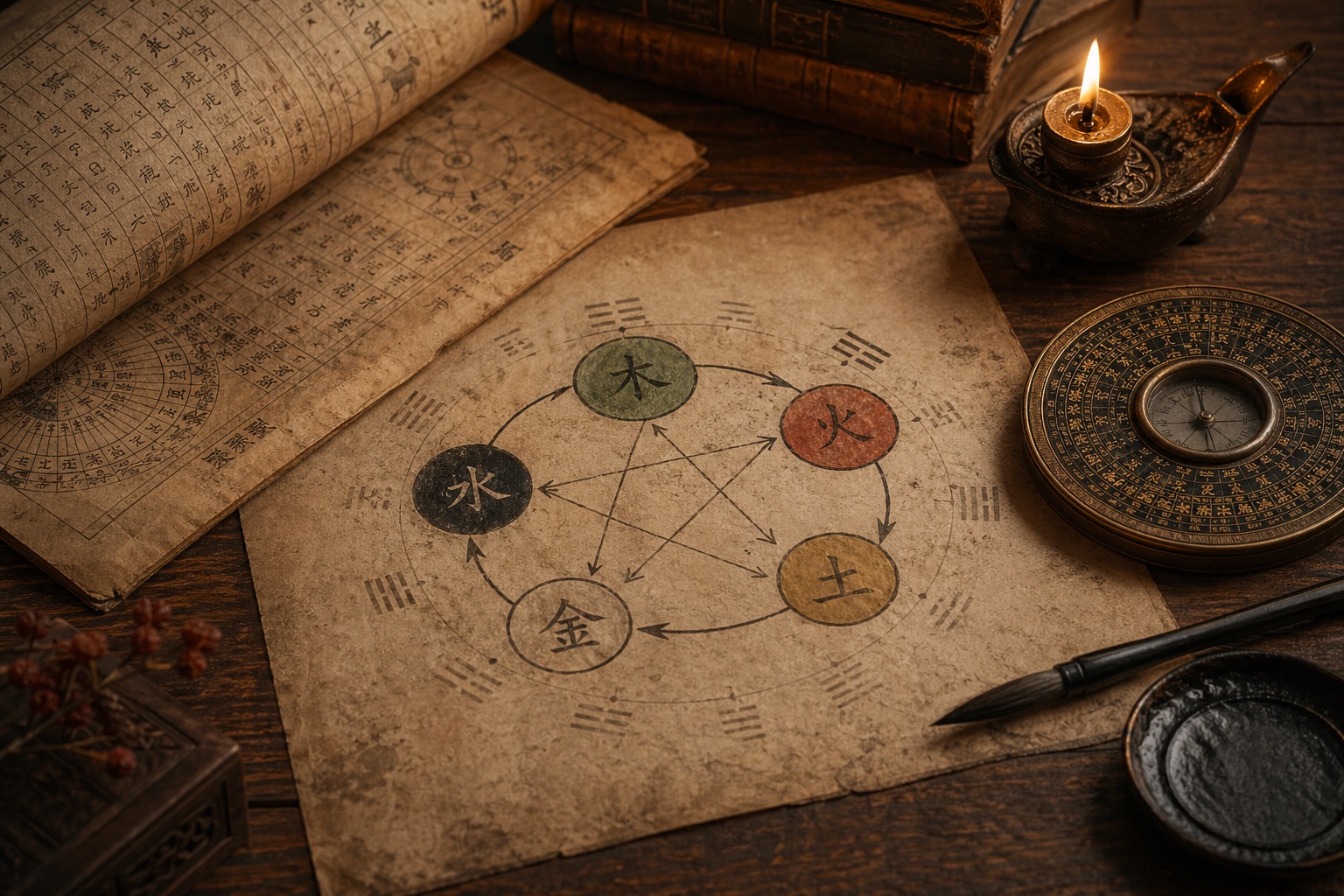
Diagram idea: generating and controlling cycles of the Five Elements
A complete Five Elements diagram usually shows two movements. The generating cycle explains how one element supports another. Wood feeds Fire, Fire creates Earth through ash, Earth bears Metal, Metal enriches Water through condensation symbolism, and Water nourishes Wood.
The controlling cycle explains restraint and regulation. Wood parts Earth, Earth contains Water, Water extinguishes Fire, Fire melts Metal, and Metal cuts Wood. Together, these two cycles show why the Five Elements are better understood as dynamic relationships rather than fixed substances.
The Five Elements as qualities, not literal materials
The Five Elements do not refer only to five literal substances: metal, wood, water, fire, and earth. They are better understood as five distinct qualities or modes of energy.
As Five Elements theory expanded, it came to influence many areas of Chinese thought and practice, including internal alchemy, diet, medicine, music, divination, geography, and feng shui.
For example, traditional Chinese theory links the Five Elements to the five internal organs, five sense faculties, five colors, five musical tones, five flavors, and five directions.
Five Elements correspondences in traditional Chinese thought
Traditional Chinese metaphysics often uses correspondences to connect the human body, the natural world, time, and space. The Five Elements are commonly linked to:
- Five internal organs: heart, liver, spleen, lungs, and kidneys.
- Five colors: green or blue, red, black, white, and yellow.
- Five flavors: sour, bitter, sweet, pungent, and salty.
- Five musical tones: symbolic tonal categories in classical theory.
- Five directions: east, south, west, north, and center.
Throughout Chinese history, the Five Elements had a lasting and far-reaching influence. In classical teachings, they are often discussed alongside Yin and Yang. That is why people often say: once you understand Yin-Yang and the Five Elements, you understand the core logic of traditional Chinese cosmology.
Heavenly Stems and Earthly Branches: organizing Heaven, Earth, and human life
In ancient times, people used the Heavenly Stems and Earthly Branches as a symbolic framework for understanding the relationship between Heaven, Earth, and human life.
The Heavenly Stems represented the way of Heaven, while the Earthly Branches represented the way of Earth. What appears in Heaven takes form on Earth, and in human life it becomes destiny and circumstance. In this view, the patterns of Heaven and Earth shape the human world.
The system of stems and branches was created to align cosmic order with time, space, and human affairs. Once Heaven and Earth were given their proper places, the stems and branches were used to organize time and space. Through time and space, the world itself could be understood.
How the stems and branches became a timekeeping system
The stems correspond to Heaven, and the branches correspond to Earth. Although all living things grow from the Earth, their flourishing and decline still depend on Heaven. The combination of the Ten Heavenly Stems and the Twelve Earthly Branches forms the Sixty Jiazi, a sixty-part cycle used to explain the relationships among Heaven, Earth, and humanity.
According to the Shiben, “Rong Cheng created the calendar, and Da Rao established the Jiazi cycle.” Based on textual records, the Twelve Earthly Branches were already in use during the time of the Yellow Emperor, each corresponding to a different month and seasonal division of the year.
By the Shang dynasty, the ten signs such as jia, yi, bing, and ding had appeared as written symbols for counting and recordkeeping. These became known as the Heavenly Stems. When combined with the Earthly Branches, such as jiazi and yichou, they were used to record years, months, days, and hours.
The Ten Heavenly Stems
The Ten Heavenly Stems are divided into yang and yin categories:
Yang Heavenly Stems
Jia, Bing, Wu, Geng, and Ren.
Yin Heavenly Stems
Yi, Ding, Ji, Xin, and Gui.
In Chinese astrology, BaZi, calendar systems, and destiny analysis, the Heavenly Stems are often used to describe visible heavenly influence, energetic quality, and the symbolic tone of a particular moment.
The Twelve Earthly Branches
The Twelve Earthly Branches are Zi, Chou, Yin, Mao, Chen, Si, Wu, Wei, Shen, You, Xu, and Hai.
They are connected to months, seasons, directions, hours, and the twelve-year cycle. In later traditions, they also became associated with the Chinese zodiac animals, but their original function was broader than zodiac symbolism alone.
The Sixty Jiazi cycle
The Sixty Jiazi cycle is one of the oldest and most influential systems in Chinese timekeeping. Ancient thinkers observed that Jupiter’s orbit around the sun takes roughly twelve Earth years. This became a basis for linking the twelve Earthly Branches to a repeating twelve-year cycle.
Because a twelve-year cycle alone was considered too limited, the ancients combined it with the Ten Heavenly Stems: Jia, Yi, Bing, Ding, Wu, Ji, Geng, Xin, Ren, and Gui.
By pairing the ten stems with the twelve branches in sequence, from Jiazi to Guihai, they created a complete sixty-year cycle. This cycle repeats endlessly and was used to mark years, months, days, and even hours.
Examples include Jiazi, Yichou, Bingyin, and so on through all sixty combinations. This system is also known as the Sixty Jiazi Spirits or the Sixty Yuanchen, and in traditional belief each combination was associated with its own name and spiritual identity.
What was the Sixty Jiazi used for?
The Sixty Jiazi is one of the earliest and most significant Chinese timekeeping inventions. It is also called the Sixty Flower Jiazi. Its oldest uses were for recording years in a 60-year cycle, months in a 5-year cycle, days in a 60-day cycle, and hours in a 5-day cycle.
In this way, the system provided a complete model for tracking time and understanding change within the traditional Chinese worldview. It also became a foundation for astrology, BaZi, date selection, divination, ritual timing, and historical recordkeeping.
Why this system still matters
The Five Elements, Heavenly Stems, Earthly Branches, and Sixty Jiazi cycle are not only historical curiosities. They remain important because they show how traditional Chinese culture understood time as patterned, relational, and meaningful.
Instead of seeing time as an empty sequence of numbers, this worldview treats time as carrying quality. A year, month, day, or hour may have a symbolic tone. That tone can then be interpreted through relationships between Heaven, Earth, human life, Yin-Yang, and the Five Elements.
Final thoughts
The Five Elements began as a way to understand the basic forces and movements of the universe. Heavenly Stems and Earthly Branches organized the relationship between Heaven, Earth, and human life. The Sixty Jiazi cycle brought these symbols into a practical system for marking time and interpreting change.
Together, they form one of the most important symbolic systems in Chinese civilization. Whether approached as cultural history, traditional metaphysics, or a symbolic language for reflection, they remain central to understanding Chinese astrology, destiny reading, feng shui, and classical cosmology.
FAQ: Five Elements, Heavenly Stems, Earthly Branches, and Sixty Jiazi
What are the Five Elements?
The Five Elements are Water, Fire, Wood, Metal, and Earth. In Chinese cosmology, they represent dynamic qualities and processes rather than only physical substances.
What do the Heavenly Stems represent?
The Heavenly Stems are ten symbolic signs associated with heavenly influence, timekeeping, Yin-Yang, Five Elements theory, and traditional Chinese astrology.
What are the Twelve Earthly Branches?
The Twelve Earthly Branches are Zi, Chou, Yin, Mao, Chen, Si, Wu, Wei, Shen, You, Xu, and Hai. They are used to organize months, hours, years, seasons, and directions.
What is the Sixty Jiazi cycle?
The Sixty Jiazi cycle is a sixty-part sequence formed by pairing the Ten Heavenly Stems with the Twelve Earthly Branches. It is used to record years, months, days, and hours.
How are the Five Elements used today?
They continue to appear in Chinese astrology, BaZi, feng shui, traditional medicine, diet, cultural symbolism, and personal reflection practices.
How to use this topic well
Use the five elements as a regulation tool. Ask what is overused, what is missing, and how your current pace needs to be balanced rather than taking the labels literally.
Sources & references