What is Zi Wei Dou Shu?
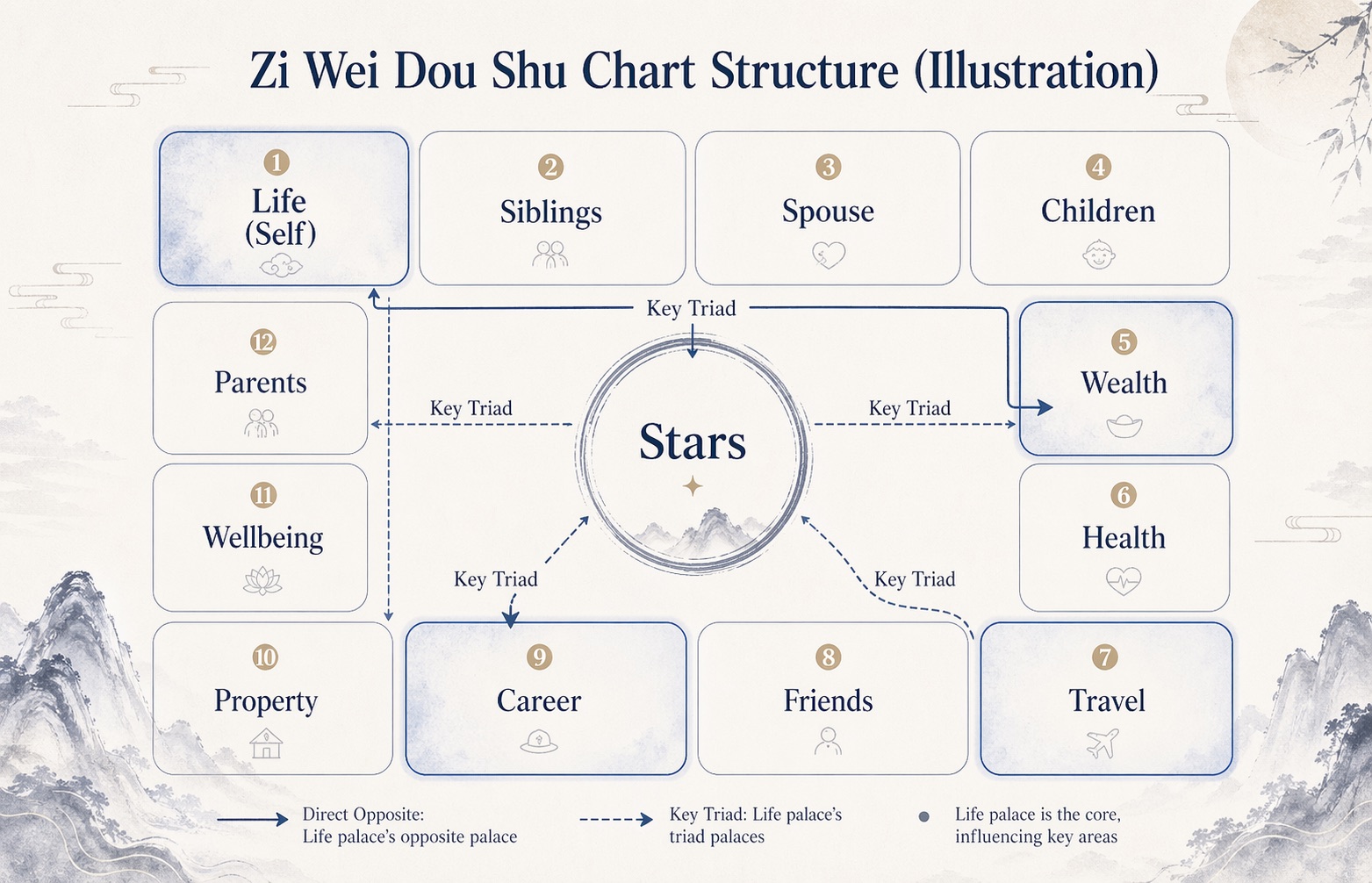
Zi Wei Dou Shu, often translated as Purple Star Astrology, is a traditional Chinese charting system that organizes life themes into 12 distinct palaces. Instead of flattening everything into one personality label, it looks at how identity, relationships, career, money, wellbeing, travel, family, and other life areas each hold their own pattern inside the chart.
That is one reason people often experience it as unusually specific. It does not simply ask, “What are you like?” It also asks, “Where does this pattern show up most strongly in your life, and what does it affect next?”
Used well, Zi Wei Dou Shu is less about chasing a single prophecy and more about gaining language for self-understanding, planning, and reflection. It is not a scientific or deterministic system, and it works best when treated as a structured lens rather than absolute truth.
How the 12 palaces make the system feel practical
The 12-palace structure is one of the easiest ways to understand why Zi Wei Dou Shu feels different from more general astrology content. Each palace points to a real area of life such as self, spouse or partnership, children, wealth, health, travel, career, wellbeing, property, parents, and social connections.
That structure gives people a practical way to read a chart. Instead of asking whether life is “good” or “bad,” the chart becomes a map of emphasis. One person may see pressure and growth clustered around work and responsibility. Another may notice that relationship boundaries or emotional recovery are the real area that needs attention first.
In everyday use, this often shifts people from vague anxiety into clearer decision-making. The chart becomes useful when it helps you ask better questions about where a pattern lives, how it repeats, and what kind of adjustment is realistic now.
How people use Zi Wei Dou Shu in real life
Most people do not use Zi Wei Dou Shu because they want one dramatic prediction. They use it because it can give language to patterns that already feel familiar but hard to describe.
Personal patterns under pressure. A chart may highlight what you default to when stressed: over-controlling, withdrawing, over-explaining, pleasing, or trying to solve everything through effort. Once you can name the pattern sooner, you can interrupt it sooner.
Relationships with less misunderstanding. Many conflicts are not really about who is right. They come from different emotional rhythms, needs for reassurance, or different boundary thresholds. The chart can work like a mirror for triggers, attachment patterns, and communication style.
Career direction through fit. People often use the chart to understand whether they thrive more with structure or freedom, deep work or visibility, solo ownership or collaboration. That turns career decisions into a question of fit rather than shame-driven self-force.
Timing through rhythm. Some approaches layer broader cycles and yearly themes onto the chart, which can help someone treat a season as a focus area: build skills, consolidate, expand, rest, or repair. That is often more useful than expecting one lucky date to solve everything.
Overseas use cases that make the system easier to understand
Singapore or Malaysia professional. Instead of asking, “Which job is lucky?” this person used the chart to define their success conditions: clear KPIs, stronger boundaries, and a weekly review rhythm. The chart became useful because it clarified the environment they needed, not because it picked one magical title for them.
Canada-based couple. One partner needed space to recover after conflict; the other needed reassurance. The chart language helped them stop moralizing their differences and turn them into one agreement: send a cool-down message, then return at a specific time to reconnect.
Europe-based creator. They used palace themes and cycle language to organize monthly content, habit planning, and work capacity. Then they compared it with real-world signals like sleep, output, and stress. That combination made the symbolic system feel grounded instead of abstract.
What Zi Wei Dou Shu is good at and what it is not
Zi Wei Dou Shu is especially good at helping people organize reflection. It can make complexity easier to talk about. It can also help people see that one life area is pulling on another, such as career pressure affecting relationship patience, or emotional instability affecting money decisions.
What it is not good for is replacing practical judgment, evidence, or real support. It should not be treated as medical, legal, financial, or mental-health advice. It is most useful when it helps you ask better questions, communicate more clearly, and make calmer decisions.
How to use Zi Wei Dou Shu without turning it into superstition
The most grounded way to use this system is to turn symbolic insight into something observable. If the chart suggests you burn out through over-responsibility, track your recovery time, workload, and emotional reactivity for a month. If it suggests that relationship tension comes from different emotional pacing, create one concrete communication rule and see whether it helps.
That is where symbolic systems become useful: not when they replace reality, but when they help you read reality with more honesty and less noise.
FAQ
Is Zi Wei Dou Shu the same as BaZi?
No. Both come from Chinese metaphysical traditions, but they organize information differently. BaZi is built around pillars and elemental structure, while Zi Wei Dou Shu is known for palace mapping and star combinations.
Why do people call it Purple Star Astrology?
That is the common English shorthand for Zi Wei Dou Shu. It usually refers to the system’s star-based structure and the role of Zi Wei, often translated as the Purple Star.
Can Zi Wei Dou Shu predict exactly what will happen?
It is better used as a reflective planning tool than as a rigid prediction machine. Most people get more value when they use it to identify themes, patterns, and better timing decisions.
Is Zi Wei Dou Shu useful if you live outside Asia?
Yes. The practical questions it helps with—stress patterns, relationships, career fit, and timing—are not limited to one region. The most useful applications are usually the most ordinary ones.
Want a clearer personal reading?
Start with a FateRune preview.
If you want structure around your own relationship patterns, timing, or career direction, begin with a free preview and see whether the full report feels worth unlocking.