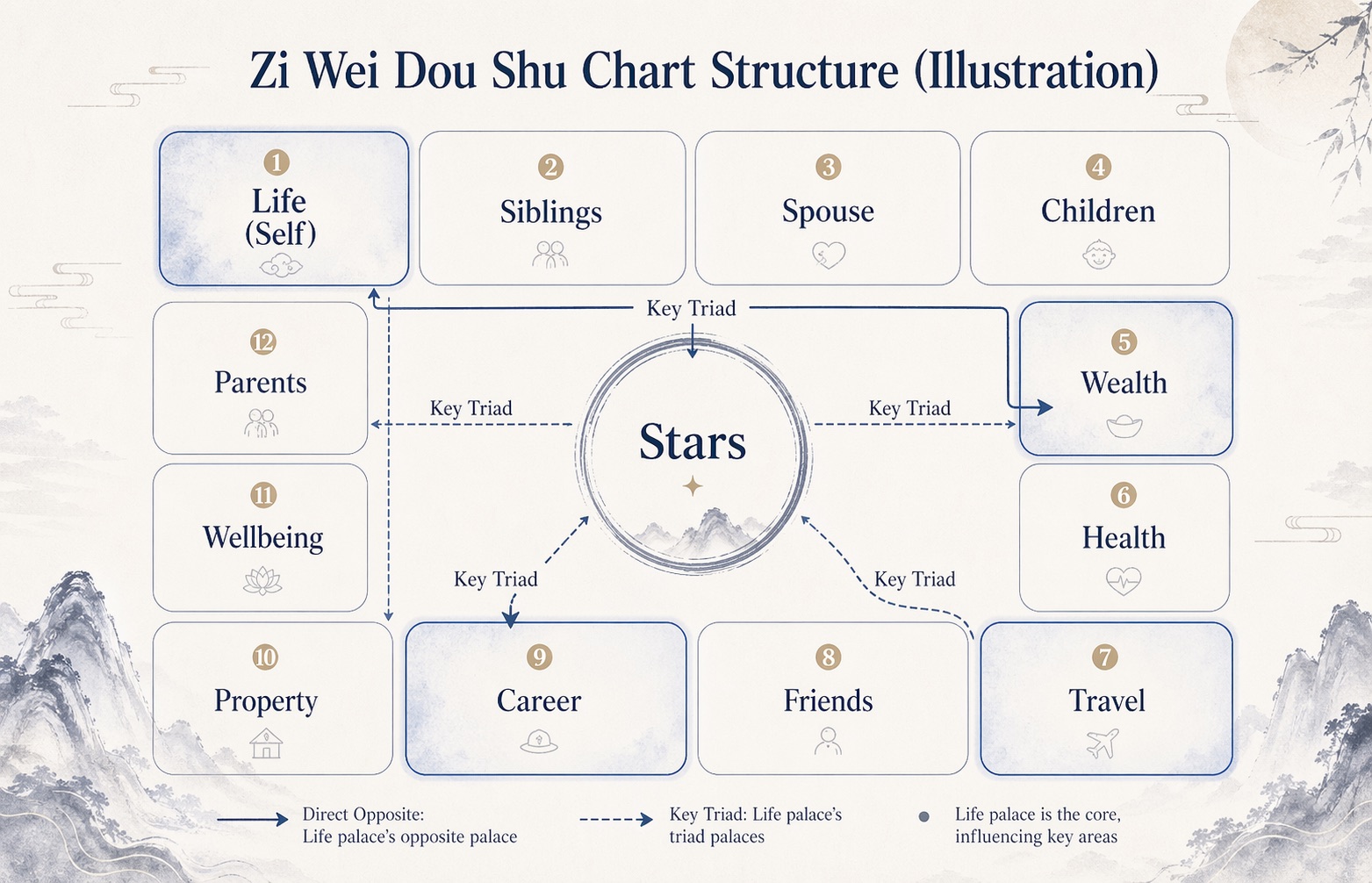
Why the 12 palaces matter so much
One reason Zi Wei Dou Shu feels easier to apply than people expect is the palace system. Instead of keeping everything abstract, it divides life into 12 connected areas. That immediately gives readers a usable framework: which area feels stable, which area feels pressured, and which patterns keep repeating between self, relationships, career, money, health, and movement.
In other words, the 12 palaces make the chart feel less like a mystical label and more like a structured reflection map.
The 12 palaces in plain English
Life (Self): your baseline temperament, core style, and how you tend to meet the world.
Siblings: dynamics with peers, cooperation, comparison, and close horizontal relationships.
Spouse: partnership patterns, attachment themes, and how intimacy often plays out.
Children: care, creativity, responsibility, and what you are nurturing over time.
Wealth: money habits, resource style, and how you manage gain and pressure.
Health: strain points, regulation, and how stress may show up through the body.
Travel: movement, relocation, changing environments, and what happens when you leave the familiar.
Friends: networks, alliances, social support, and the kind of people you draw in.
Career: public role, achievement style, work identity, and the environments where you function best.
Property: home base, foundations, stability, and your relationship with long-term security.
Wellbeing: emotional recovery, internal peace, and how you restore balance.
Parents: authority patterns, inheritance, family conditioning, and your relationship to support and expectation.
How people use palace patterns in real life
The palaces are most useful when they turn vague anxiety into specific questions. If the spouse palace and self palace keep pulling on each other, the practical question becomes: what part of closeness feels threatening or draining? If the career and travel palaces are active together, the practical question may be whether growth requires movement, a new environment, or a different kind of exposure.
This is where Zi Wei Dou Shu becomes genuinely practical. It helps people ask better questions about the part of life that is asking for attention, instead of treating every problem as a generic fate issue.
How to read the 12 palaces without becoming overly literal
The palace system works best when used as a language for tendencies, not a rigid script. A stressed wealth palace does not mean financial ruin. A strong travel palace does not automatically mean you must move abroad. The useful reading is more nuanced: where is your life asking for adaptation, what kind of environment changes your outcomes, and what pattern gets repeated if you ignore it.
That mindset keeps the chart grounded. It becomes a planning tool, not a superstition loop.
FAQ
Do the 12 palaces predict fixed outcomes?
No. They are more useful as a structured way to read life themes, recurring pressure points, and areas that may need attention or better decisions.
Which palace is the most important?
Many readers begin with the Life palace because it sets the tone for the chart, but the most relevant palace depends on the question you are trying to answer.
Can the 12 palaces help with career and relationship clarity?
Yes. That is one of the most practical uses of the system. The palace structure helps separate different life themes so you can think about them more clearly and less emotionally.
Want a reading that turns symbolic structure into practical clarity?
FateRune reports are designed for people who want emotional insight with structure, especially around personality, timing, love, and career direction.